Feast
Empowering organizations to manage and transform data for production machine learning applications through open-source Feast as a feature store and orchestrator.



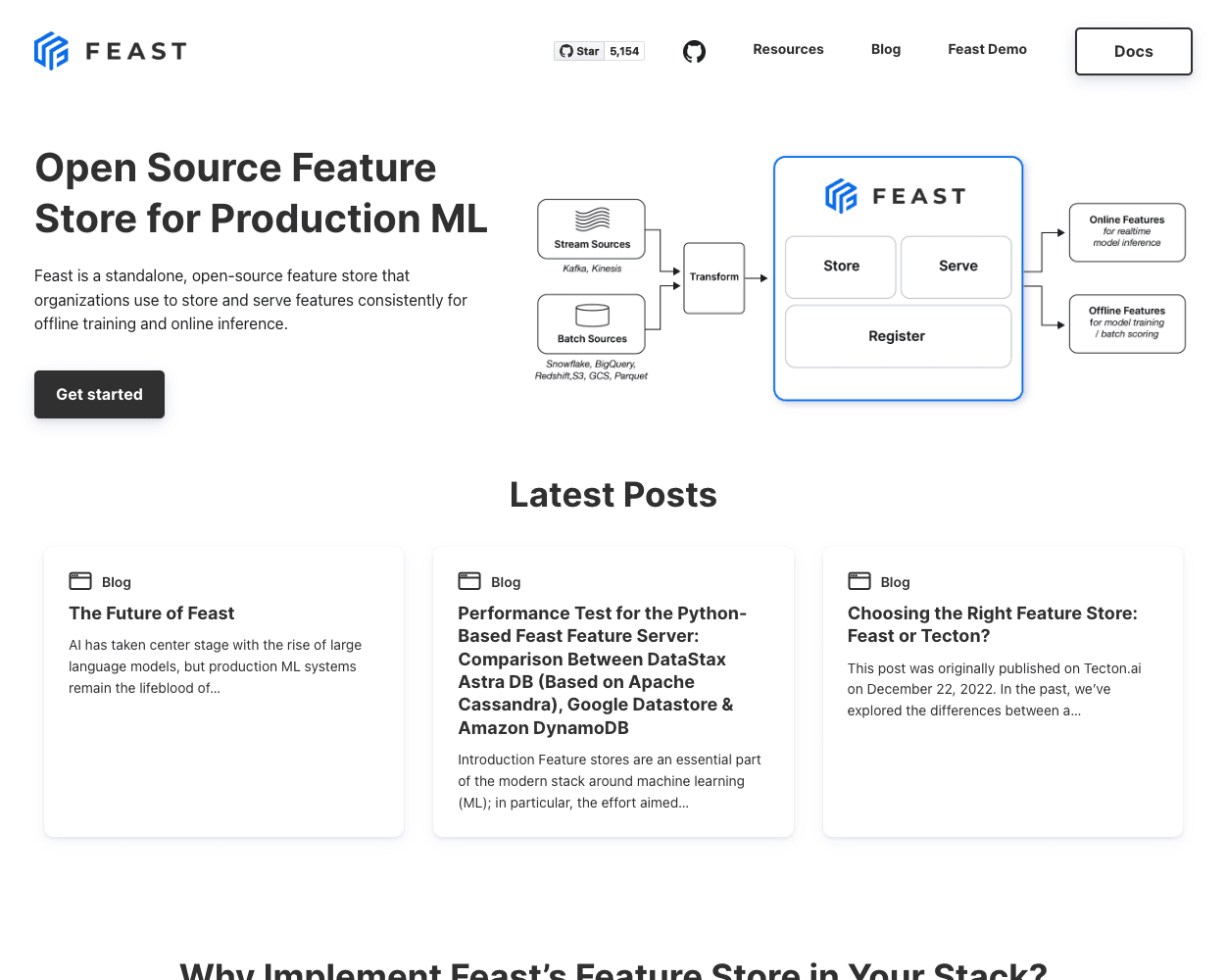
Feast is an open-source tool that manages data across various systems for machine learning applications as a feature store, enabling consistent management of data between offline training and online inference environments. It functions as a component of a feature platform, orchestrating data infrastructure for transformation, storage, and serving. Feast allows organizations to manage feature definitions using git-like repositories and perform feature engineering with SQL, PySpark, SnowPark, or Python. It supports on-demand transformations to generate features, with plans for lightweight feature engineering. Users typically employ Feast alongside a separate system for computing feature values.
About Feast
Feast is an open-source tool that helps manage data stored in various systems, such as BigQuery, Cloud Firestore, Redshift, and DynamoDB. It is not a database itself but serves as a feature store, ensuring consistent management of data across offline training and online inference environments.
Feast functions as a core component of a feature platform, which orchestrates existing data infrastructure for continuous transformation, storage, and serving of data for machine learning applications. The key difference between Feast and a managed feature platform like Tecton lies in the support for transformations: users migrating from Feast to Tecton need to rewrite their transformations or have Tecton ingest features via FeatureTable or the Ingest API.
Feast is designed to store and serve features for production machine learning, allowing organizations to manage feature definitions as files in a git-like repository and perform feature engineering using SQL, PySpark, SnowPark, or Python. It enables on-demand transformations to generate features that combine request data with precomputed features, while plans exist to support lightweight feature engineering as well. Most users employ Feast alongside a separate system for computing feature values, often in the form of pipelines managed by SQL or a Python Dataframe library and scheduled to run periodically.